Hy2Car / HyMob
Nancy Hydrogen Platform for Experimenting with Decarbonized Light Mobility
The Hybridized Hydrogen Car (HY2CAR) project aims to develop a vehicle whose power output is tailored to urban and peri-urban travel. This electric vehicle, designed to consume less energy than most current models, is also intended to be as affordable as possible.
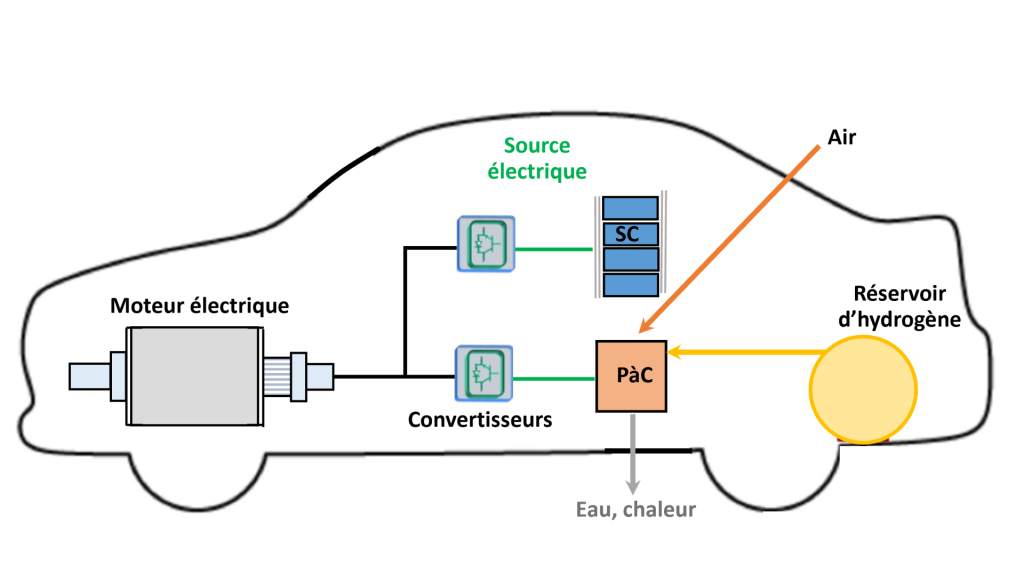
The vehicle’s energy architecture is based on a PEM fuel cell, directly hybridized with supercapacitors. For a vehicle weighing around one tonne, a total maximum power output of 30 kW, including a 10 kW fuel cell, is sufficient for use in urban and nearby suburban environments.
The concept has already been validated in the laboratory using a 15 kW power source, including a 5.6 kW PEM fuel cell and 0.5 kWh of supercapacitors.
We are currently working with Gustave Eiffel High School in Talange to install this power source in a car that will serve as a rolling demonstrator.
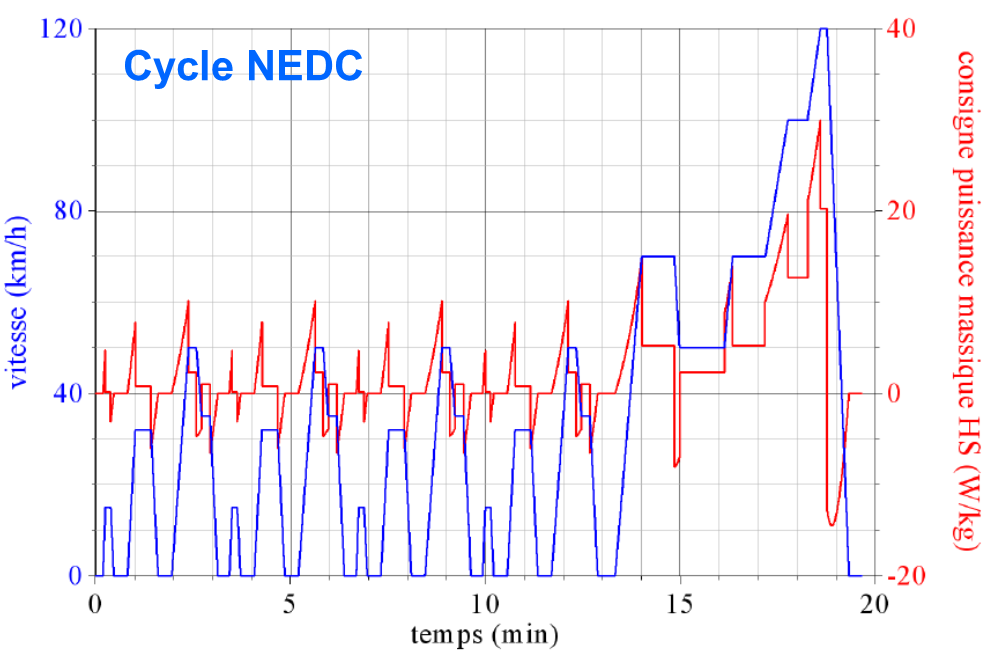
In the figure, plotted for a level-road profile, positive power corresponds to power supplied to the motor, while negative power corresponds to power recovered during braking and deceleration phases.
It can be seen that 30 kW per tonne of vehicle mass is required to reach a peak speed of 120 km/h under the standardized NEDC cycle. In practice, however, in suburban areas, most peri-urban roads are limited to 70–90 km/h.
1. Benefits of a Fuel Cell and an Energy Storage System
As an energy source, the fuel cell offers several advantages :
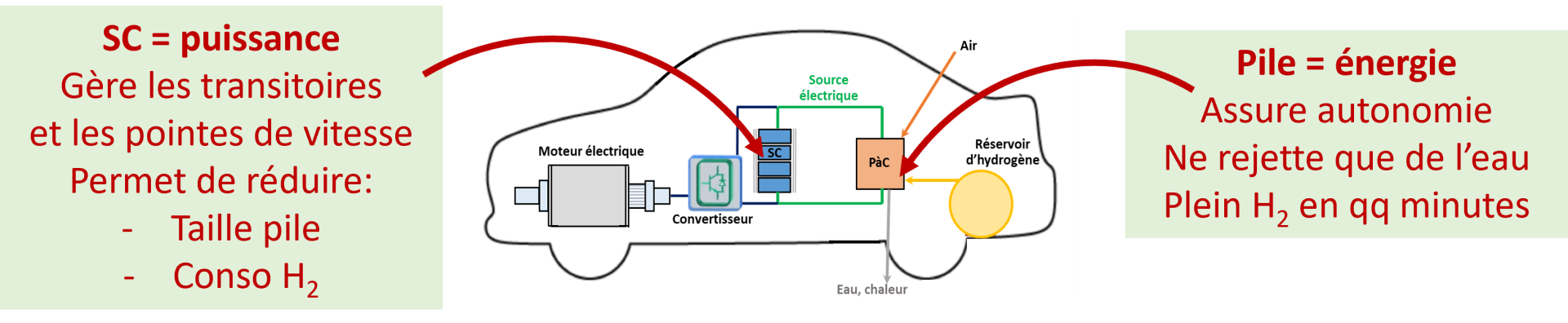
- ensures vehicle range;
- provides the average power demand;
- emits only water;
- can be refueled with hydrogen in just a few minutes.
When combined with an energy storage system, the fuel cell does not need to be oversized to handle peak power demands.
As a power source, the energy storage system offers the following advantages:
- provides power during transitions, such as acceleration;
- delivers peak power during demanding phases, such as uphill driving;
- recovers braking and deceleration energy (this energy represents around 25% of the energy used for vehicle motion);
- when combined with a fuel cell, it no longer needs to be recharged from the electrical grid.
2. Advantages and Disadvantages of Supercapacitors vs. Batteries
Supercapacitors
- more sustainable technology (no precious or rare metals);
- longer service life;
- improved safety;
- can be fully recharged in just a few minutes.
Batteries
- higher energy density, making them more versatile than supercapacitors.
3. Hybridization
a. Direct Hybridization
Direct hybridization eliminates the need for one power electronic converter. This technological choice offers several advantages:
- reduced system size and weight;
- lower overall vehicle cost;
- lower risk of failure;
- improved energy efficiency.
In addition, the lifetime of the fuel cell is extended due to the absence of high-frequency electrical ripple, which promotes more stable and smoother operation.
However, fuel cells currently available on the market do not reach nominal voltage levels equivalent to those of supercapacitors. To overcome this limitation, the project relies on a segmented architecture, in which several fuel cells are connected in series.
A start-up support system is also provided when the supercapacitor voltage is too low at start-up. The selected solution is based on a simple dissipative system.
b. Indirect Hybridization
Indirect hybridization makes it possible to combine a fuel cell with supercapacitors despite their very different nominal voltage levels, while ensuring control of energy flows.
However, this architecture also has several drawbacks:
- the presence of switching harmonics, which may reduce fuel cell lifetime;
- increased system weight and volume;
- higher cost;
- greater risk of failure;
- higher energy losses.