
Continuation of the Hy2Car Project
1. Ongoing Integration of a 15 kW Electrical Power Source
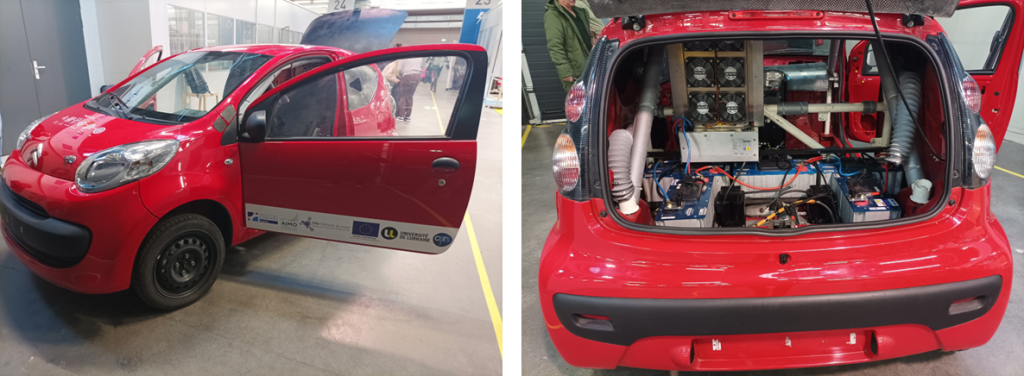
The ongoing project involves the integration of a 15 kW hybrid direct-coupling fuel cell/supercapacitor electrical power source into an operational vehicle, in collaboration with Gustave Eiffel Vocational High School in Talange.
2. A Broader Perspective Beyond the Prototype
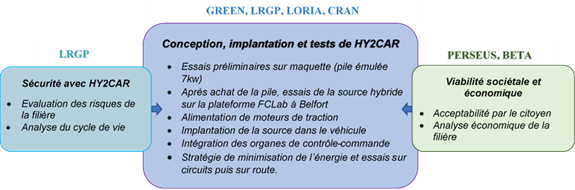
Beyond the technical development of the prototype, it is essential to adopt a broader perspective by considering the future user, the industrial sector in which the vehicle is positioned, and by comparing the risks and life cycle assessment (LCA) of the hybrid vehicle with those of vehicles currently available on the market.
3. Exploring PEM Fuel Cell and Power Battery Direct Hybridization
As supercapacitors discharge too quickly during steady-speed driving, we are also investigating direct hybridization between a PEM fuel cell and a power battery. Unlike supercapacitors, power batteries require a Battery Management System (BMS) to monitor their state of charge, state of health, and operational status.
Since direct hybridization no longer relies on a converter to control the battery, there is a need to develop a robust battery management system with low computational demand, suitable for transport applications. To address this, nonlinear state observers based on local electrochemical battery modeling are currently under development.
Characterization Techniques
Electrochemical Characterization of Energy Storage Systems
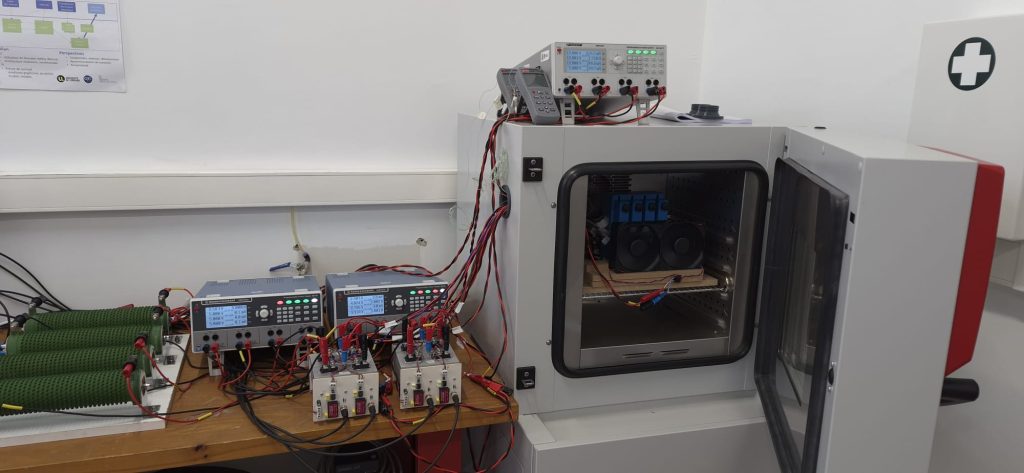
At the HyMob laboratory, we investigate the electrochemical behavior of energy storage systems, particularly batteries and supercapacitors. Our research aims to improve understanding of their performance, stability, and long-term evolution.
Charge–Rest–Discharge–Rest Cycling
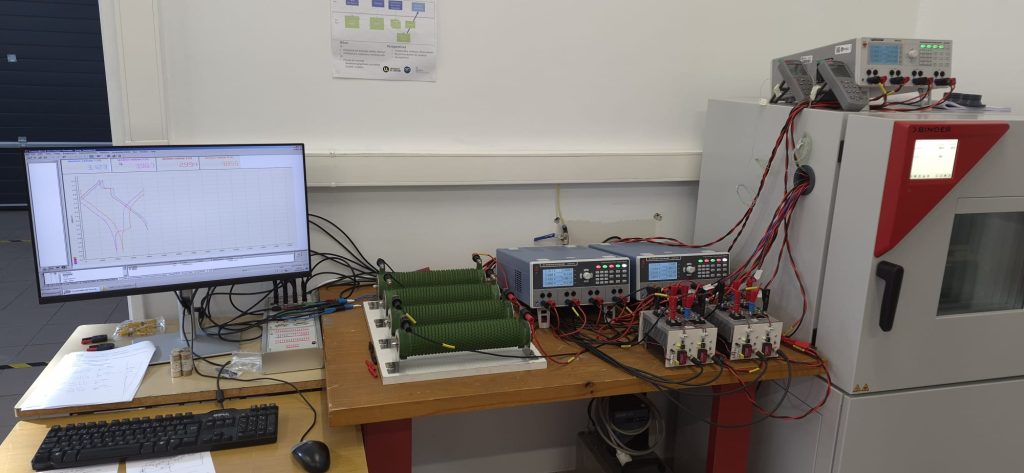
We perform electrochemical cycling tests using various operating sequences, such as charge–rest–discharge–rest, in order to analyze cell response under controlled conditions. These tests make it possible to evaluate capacity, efficiency, stability, and relaxation phenomena.
CC–CV Charging Protocols
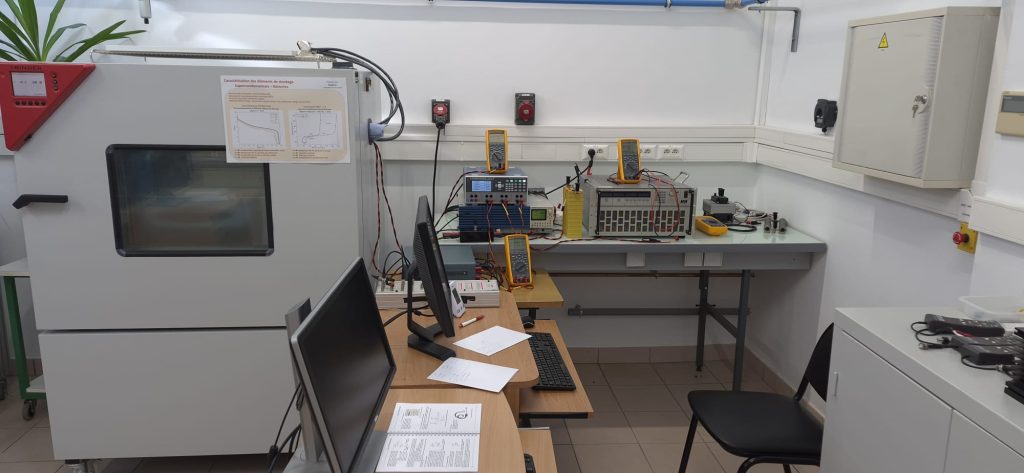
We also use constant current–constant voltage (CC–CV) charging protocols to characterize how cells charge, identify their behavior at the end of charge, and monitor their evolution during aging.
Aging and Durability Studies
Our work also focuses on the aging behavior of energy storage systems. By repeating charge and discharge cycles, we observe changes in performance, capacity fade, internal behavior, and the durability limits of the devices.
Energy and Power Performance Analysis
The laboratory evaluates the energy and power performance of the systems under study in order to determine their suitability for a range of applications, including mobility, hybrid systems, and stationary energy storage.
Study of Relaxation Phenomena and Dynamic Response
We analyze relaxation phenomena, charge redistribution, and the dynamic response of cells after charge or discharge, with the aim of gaining a deeper understanding of the internal mechanisms governing their operation.
Electrochemical Data Analysis
Experimental data collected in the laboratory are processed to identify the characteristic signatures of electrochemical cell behavior, interpret their internal mechanisms, and compare different materials or technologies.
Developing Solutions for Mobility and Energy
Through its research, HyMob contributes to the development of innovative solutions for sustainable mobility and energy storage, relying on a rigorous experimental approach and an in-depth understanding of electrochemical materials and systems.