
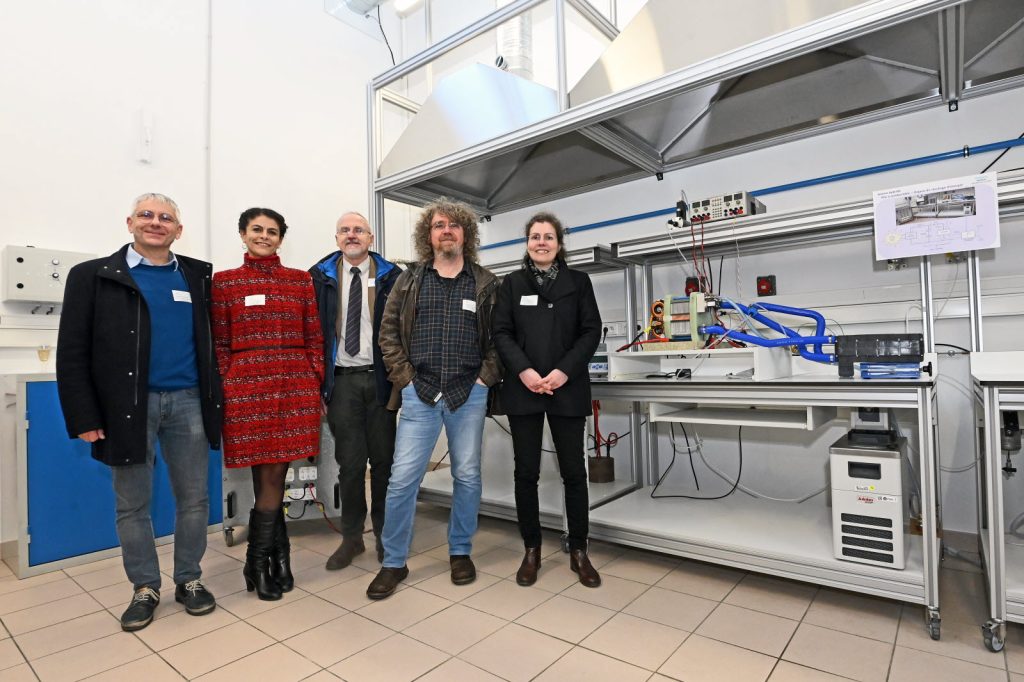
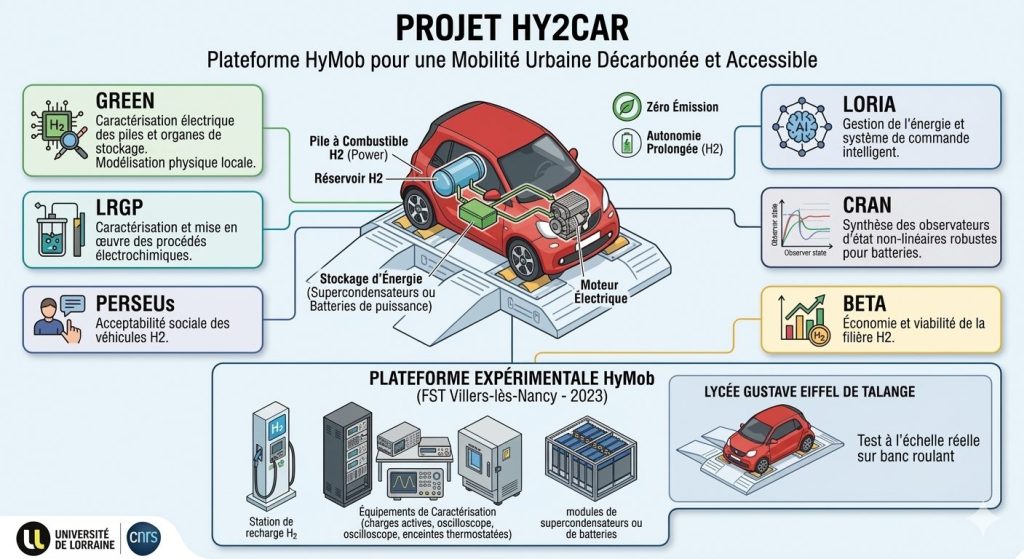
The HyCar project brings together 25 faculty members and researchers affiliated with several laboratories at the University of Lorraine, representing a broad range of disciplines across engineering sciences, human and social sciences, and economics :
- LRGP (process engineering)
- CRAN (automation and control systems)
- LORIA (computer science)
- GREEN (electrical engineering)
- PErSEUs (psychology / ergonomics)
- BETA (economics)
More recently, the consortium has expanded to include colleagues from the Gustave Eiffel Vocational High School in Talange.
Our main research focus is on decarbonized urban and peri-urban mobility that is accessible to the widest possible audience, with hydrogen as an energy carrier, directly coupled with energy storage systems such as supercapacitors and batteries.
To support this ambition, the consortium has developed a high-power hydrogen platform, known as the HyMob platform, located on the campus of the Faculty of Science and Technology in Nancy.
This platform is equipped with facilities for the characterization of electrochemical devices, including power supplies, high-power active loads, temperature-controlled chambers, rapid prototyping platforms, potentiostats, boosters, precision probes, and high-precision oscilloscopes. It also includes energy storage devices (supercapacitors, LTO-NMC cells, and graphite-LFP cells), high-power fuel cells, an electric vehicle with a hydrogen range extender, a hydrogen refueling station, and ATEX-certified safety equipment.
Partners and Funding Bodies
- Project labeling by the Pôle Véhicule du Futur (PVF)
- European Regional Development Fund (ERDF)
- Air Endowment Fund (AtMO Grand-Est)
- Lorraine Université d’Excellence (LUE)
- Académie des Métiers et Professions de l’Hydrogène décarboné (AMPHy) project
- Carnot Institute ICEEL
- Energy, Mechanics, Processes and Products Scientific Cluster (EMPP)
- Jacques Villermaux Federation (FJV)